
Australia’s R-Series Passport Moves into New Security and Design Paradigm
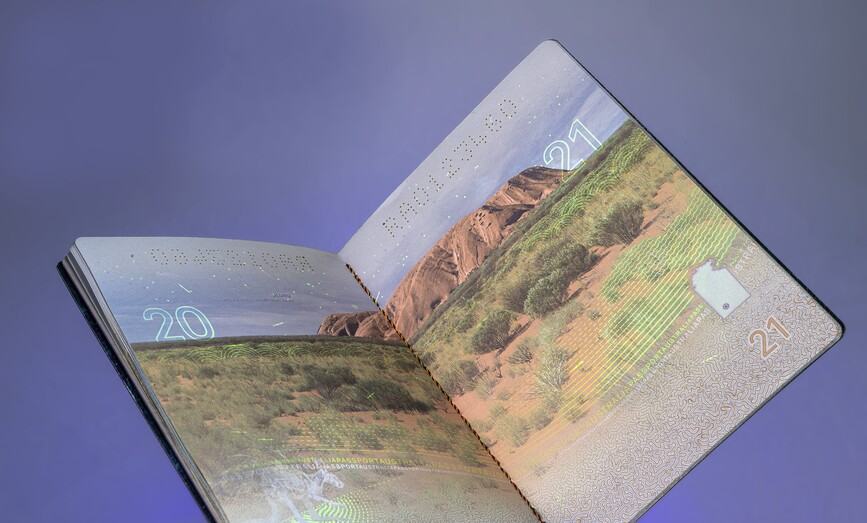
Since winning the contract to manufacture the entire Australian passport in 2002, the R-Series is now the fifth series that Note Printing Australia (NPA) has developed for the Australian Passports Office, and by some margin the most ambitious book NPA has ever manufactured.
Thanks to the addition of a new set of technologies built from the ground up, the R-Series will take its place in Australia’s passport history as taking the national security document into a new security and design paradigm. The major security driver of this shift is the addition of a polycarbonate data page, supplemented with enhanced design based on a new printing capability to create vivid, bold imagery across double pages.
Australia’s polycarbonate data page, manufactured by De La Rue, involved a complete rethink of the technology to eliminate potential vulnerabilities and take full advantage of the 3D space that a polycarbonate page provides. This includes the use of clear windows and integrated security features that not only make the data page more secure but continues the legacy of Australian security documents that use clear windows as a security feature – the polymer banknote being another highly successful anti-counterfeit example.
Responding to the opportunity of rethinking the design and presentation of Australia’s magnificent landscapes and wide colour palette, the NPA team invested in new equipment to enhance the design opportunities in wet-offset with more complex design options made possible by additional print units. Never before has the Australian landscape been presented so beautifully and vividly in an Australian security document, with the colour range printed with a fidelity and resolution.
Portraying a ‘north-about’ journey around Australia as one progresses through the passport pages, NPA took a progressive design approach that offers minimal disruption to the landscape visual. The effect is achieved through a tonal imaging treatment combined with the latest security patterns to construct the photographic image with layered elements supporting the location narrative, with each landmark identified and its location acknowledged by a graphic of the relevant state or territory.
The image’s composition is divided into parts to create a visual hierarchy. This method creates an effect that transforms the 2D flat exposure into several planes that engages the viewer’s sense of space and perspective, and also creates an opportunity to mute tones.
Every visa page spread has a unique nightscape – lunar phases, starry nights, Milky Way, dusk and twilight – visible only in ultraviolet light. The high-definition image of a fauna species native to that state or territory also becomes visible in the lower left corner of each visa page spread. All visa pages contain invisible banded security fibres which fluoresce under ultraviolet light. On every second page spread, multi-coloured StarLites™ are visible across the sky.
Endpage of passport (© NPA).Other new design elements and technology upgrades have been added to the series book that have improved both the security and aesthetic of this iconic Australian document. These security upgrades include:
An enhanced foil emboss on the front cover of the book, which incorporates greater fidelity and detail thanks to an improved foil emboss process.
A blind deboss of two kangaroos on the back cover of the book.
The stitching format being upgraded to an interlock with new UV effects.
An upgraded laser perforation capability for the serial number in the passport, to include not only round circles, but squares and stars being included in the number format.
From the start of this project, the inclusion of Indigenous design elements made an important contribution to the R-Series passport design theme, namely ‘Yumari’ (1981) by Uta Uta Tjangala, and ‘Possum and Wallaby Dreaming’ (1985) by Michael Nelson Jagamara. Both are iconic Indigenous artworks, with Possum and Wallaby Dreaming selected as the mosaic design used in the 20m x 9m forecourt of Australia’s Parliament House, which was completed in 1988.
Imagery from Yumari has been evolving through previous Australian passport series – Yumari featured on both the N-Series in lithography print and the P-Series in intaglio print. When considering the Indigenous references in the past passports, Yumari design elements for the R-Series have continued to be present, this time through the paper substrate of the passport as a watermark which was developed and supplied by Portals.
‘This could be seen as a metaphor for the fabric of our country. In order to convey this message, we needed to forge a symbol to represent the deep cultural connection that is fundamental to the identity of First Nations peoples,’ says NPA Lead Designer André Vancell. ‘To build this connection, our interpretation of the artwork was used to symbolise the eight states and territories as each successive double-page spread journeys through Australia. All 17 location images in the passport are printed with the Yumari narrative in the background.’
In addition, every second double-page spread has a detailed, high contrast electrotype watermark in the form of a kangaroo, best viewed when held up to a light source. The kangaroo borrowed from the Australian Coat of Arms on the Passport cover, follows the R-Series journey throughout the different locations being positioned on the horizon of each image. This theme then extends out as a blind deboss on the back cover.
The position of Uluru – the awe-inspiring monolith located in Australia’s ‘Red Centre’ – is appropriately located in the centre spread of the passport and resonates as a representation of First Nations people. The interlocked stitching of red, grey and white thread is visible between the centre pages, its colour theme selected from Yumari. Under ultraviolet light, the thread switches to red, yellow and black – the colours of the Aboriginal flag.
The background design and tactile features from Possum and Wallaby Dreaming flow down from the observations page. The painting has also informed the positioning of certain security features on the polycarbonate data page. On the important information page, an element from the Possum and Wallaby Dreaming is printed in both visible and invisible ink which fluoresces white and red under ultraviolet light.
After the Australian Passport Office distributed more than 300 sample packs of the new passport books, the global reaction to the R-Series passport from the world’s issuing authorities has been extremely complimentary. For NPA, it reinforces this organisation’s commitment to making ambitious security printing goals a reality.
‘New ideas and the innovation needed to make it happen had to be given time to develop – they needed time to breathe a bit. Any number of obstacles could have derailed this project, but we allowed ourselves the time and the mental space needed to think through these issues and keep subscribing to the vision,’ says Michael Griggs, NPA Principal Technical Officer. ‘That discipline was driven by a cultural expectation at NPA that we’ll get it done. We never doubted that we could do it – NPA is quite unique in this regard in that we are always willing to take on challenges like this.’
Subscriber content
Read the full article
Full access to ID & Secure Document News articles, newsletters and archives.