Government of Monaco and IN Groupe – a Solid Partnership for Success
In this next episode of the occasional series of country profiles, Francis Tuffy (Editor of ID & Secure Document News™) took on the hard task of visiting the beautiful Principality of Monaco to find out about the government’s strategy for connected digital identity… and conclude some unfinished business.
Monaco is the second smallest and most densely populated sovereign state in the world. But despite its size it punches above its weight on the world’s stage. And maybe because it is so densely populated it turns out, amongst the motor racing, the yachts and the glamour, to be very good at identity management.
Since the end of June 2021, every Monaco citizen and resident has been able to have a digital identity associated to their new ID card. This digital identity makes verification both easier and highly secure, with no additional proof of identity needed to access the different procedures that citizens may want to initiate with state or private partner services.
The introduction of the electronic citizen identity is part of the ‘Extended Monaco’ programme that aims to make the principality a model for digital transformation.
‘When a citizen volunteers to enrol in the system,’ explained Laurent Beaubiat, during my visit to Monaco earlier this month, ‘their biometrics are captured and they are issued with an ID Card or Residence Permit – dependent on their status. They also sign a document that essentially confirms that they accept their newly enrolled digital identity can be used as an equivalent to their physical identity.’
This is an important point for the government, as the legislation that was taken into law makes it clear that enrolling in the new identity is voluntary and not compulsory.
Laurent continued to emphasise this point: ‘nobody is forced to join, but the vast majority of citizens have.’
The card itself, provided by IN Groupe, complies with Monaco legislation around data protection, meets government expectations, and aligns with the physical and digital uses of Monaco citizens and residents of the principality. The digital IDs are designed to be interoperable with all European electronic identification services, and comply with the latest eIDAS, OSIA, and Open ID Connect standards.
After Laurent had completed the tour of the impressive enrolment facility (temporarily housed adjacent to the iconic Stade Louis II), it was time to conclude that unfinished business.
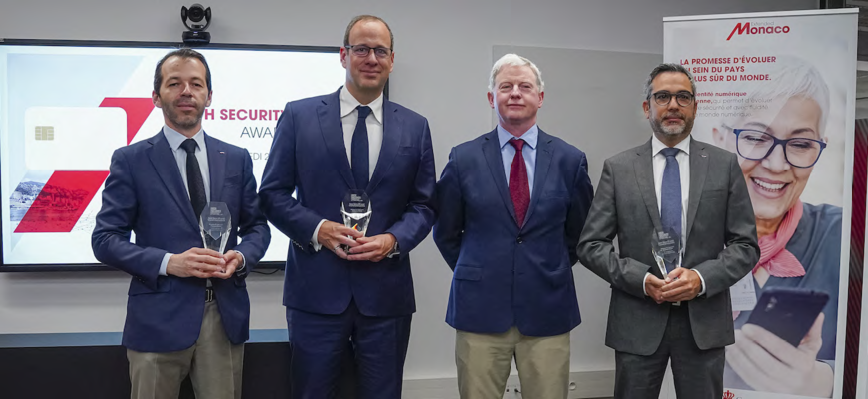
A highlight of Reconnaissance’s series of High Security Printing (HSP) conferences is the judging and presentation of the regional awards for the best banknote and ID projects from that year. Like many events during the pandemic, ‘The Regional Banknote & ID Document of the Year Awards 2021’, to give the ceremony its proper title, was forced to go online and was livestreamed in December 2021 to virtual audiences across Asia, EMEA and the Americas. During the virtual event, the award for ‘Best New ID or Travel Document’ was presented to the Monaco Government and IN Groupe for the Monaco ID Card and Resident Permit.
But now, as we see travel restrictions being slowly lifted around the world, it seemed a good opportunity to present the award, in person, to Frédéric Genta – Member of Government in charge of Digital Affairs – during a short ceremony at the government offices in Monte Carlo. Other members of the team that worked on the project were in attendance, including Nicolas Croesi, in charge of Digital Transition, and Christophe Prat, Director-General of the Ministry of the Interior.
What was impressed on me, time and again, during my visit was that the link between the physical and digital has unlocked a range of possibilities for secure eServices beyond citizen entitlement and, now that the card-platform interface has been demonstrated to be robust and secure, the architects of the system are looking to go further.
Monaco now offers a digital identity that meets the highest global technological standards and is backed by a sovereign identity document. Monegasque nationals and residents can obtain a digital identity that is tied to their new identity card.
In addition to their traditional purpose, these digital ‘keys’ open up access to online services from public authorities and private partners, thanks to unique secure authentication that comes from linking access to the platform through a digital interface with the physical document.
The digital identity can also be used to sign or co-sign a document electronically from the user’s computer or smartphone, and this signature has the same legal force as a handwritten signature, to make sworn statements, or a civil registration certificate, or to log into the government’s one stop portal. As a result of partnerships with Monaco Telecom and the electricity and gas supplier SMEG, users can also securely access their utilities accounts.
My short, but highly informative, visit to Monaco has reinforced my opinion that rather than working through a period of wholesale replacement of physical ID documents by digital identities, the most useful use cases in our industry are coming from exploiting the co-existence between the two.
Subscriber content
Read the full article
Full access to ID & Secure Document News articles, newsletters and archives.