
· 4 min read

The 20-Year History of Estonia’s eID Card

Francis Tuffy
Francis Tuffy · Editor
The 20-Year History of Estonia’s eID Card

Estonia has, for a long time, been recognised as a tech-savvy country – boasting the highest number of tech-startups per person in the world.

It took a step further into the eState provision of citizen services in 2002 with the introduction of the ID card. The whole idea behind the eState in Estonia is based on the ID card and the system built on its chip. Countless citizen hours have been saved thanks to being able to do daily activities and transactions, such as declaring income, eVoting, and buying real estate, without leaving home.

‘By now, we take this merit for granted.’ said Mark Erlich, an expert in the field of electronic identity at the Estonian Information System Authority (RIA). ‘New generations have not had to experience the bureaucracy and inconvenience that preceded the digital age. We are the only country in the world that uses a digital identity guaranteed and secured by the state, where people are used to using digital services, and where there is a high level of trust, thanks to which we have been able to conduct eVoting, for example, since 2005.’ 

‘Estonian people depend on digital services, and it is very important that we acknowledge the dangers that come with the convenience. The security vulnerability discovered on the ID-card chip in 2017 and the inconveniences associated with updating the cards gave us a good lesson and highlighted the clear need for alternatives. If something happens to one tool, it must be possible to use another. Therefore, the number of mobile-ID users has increased by half since 2017 and the number of Smart-ID users has tripled,’ added Erlich.

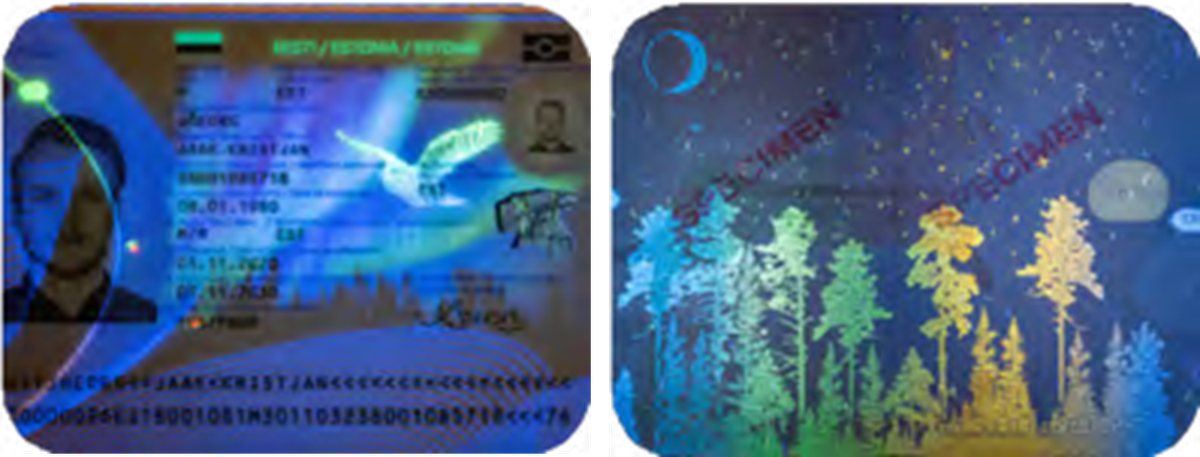
During the past 20 years, five versions of the ID card, with different designs, have been in use. The biggest visual changes can be seen in the cards that the Estonian Police and Border Guard Board (PBGB) started issuing at the end of 2018. ‘Estonian nature and national elements, such as the Estonian coat of arms, the national bird (the barn swallow), and boulders play an important role in the design of ID cards. When looking at the ID card in UV light, national motifs and the image of a lynx living in our forests become visible,’ described Eliisa Sau, Chief Expert of the PBGB Identity and Status Bureau

Sentences describing the special nature of Estonia are also written on the ID card in small print. For example: ‘Estonia has diverse national parks and exciting protected areas, where nature, culture, and history are closely intertwined. For a small area, the diversity of our landscapes is unique in Europe,’ she said.

The ethos of incorporating the culture of the country into its government issued documents is seen again in Estonia’s ePassport booklet (see IDN June 2021). For this project, PBGB partnered with HID Global to deploy a solution that consisted of an updated ePassport booklet with a host of enhanced security features.

HID also provided three software modules that integrated into the Estonian government’s existing identity management and X-Road® systems, which met their stringent requirements for personalisation, quality assurance and inventory control – tracking each booklet from the manufacturing facility to the conclusion of the personalisation process.

The passport was so well received that it won the HSP (High Security Print) Award 2021 EMEA in the category of Best New Passport, for which the judges commented that the document design was able to capture the balance between the natural and synthetic worlds that are so popular in this Baltic state.

To make it accessible to as many citizens as possible, the most convenient and affordable way to apply for an ID card is through the self-service portal of the Police and Border Guard Board – 45% of all ID-card applicants use this option. The first Estonia ID cards were ceremoniously handed over on 28 January 2002 in the Old Town studio in Tallinn, and the first document was received by President Arnold Rüütel. In 2002, 117,609 ID-cards were issued.

The ID-card numbers

A testament to the success of Estonia’s eCard is seen from theses operational statistics:

  • 4.06 million ID-cards issued (including ID-cards for 57,900 EU citizens and 350,000 foreigners) for a population of 1.33 million 

  • 1.49 million ID-cards in use

  • 12.5 million ID-card transactions per month

  • 3 million digital signatures per month 

  • 200,000 active ID-card users (electronically)

  • 54.7% of voters vote electronically (ID-card or mobile-ID)

  • 251,000 mobile-ID users

  • 615,000 Smart-ID users.

Subscriber content

Read the full article

Full access to ID & Secure Document News articles, newsletters and archives.

Sign Up to ID & Secure Document News Weekly

Receive regular updates on the latest news and articles posted on our website.

Verity

Verity

AI search assistant

Ask me anything from the ID & Secure Document News archives.

free questions remaining